PowerPoint images are commonly called "slides." I even used the term slides in my book title, Slides for Students.
So, where does this term "slides" come from? Nothing is actually moving or sliding when displaying a PowerPoint presentation. It must strike some younger people as odd. Digging into the history of modern presentations is required to understand this terminology.
Before the mid-1990s, the best way to do a professional presentation with images was to present the images via a slide projector. A similar approach was to show images to the audience via transparencies on an overhead projector. This method was considered inferior to slide projectors though.
The slides were plastic or cardboard frames that contained a translucent image.
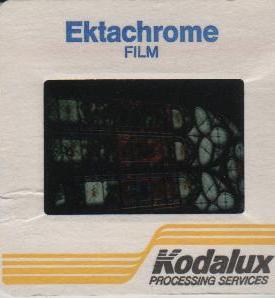
The slide image can be seen better if a flashlight is shown through it. That's essentially how slide projectors worked: Bright lights shown through transparent film images. This image is a stained glass window.

The images were lined up on slide trays. Each slide would move from the slide tray into the projector when it was needed. The image would then be displayed by shining a bright light through it. This movement from the tray to the projector was the sliding action. The finger points to the place where images moved.
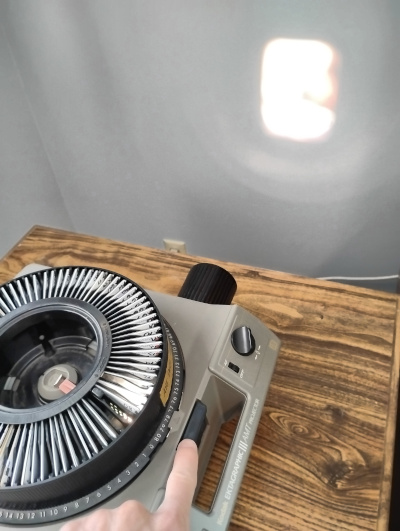
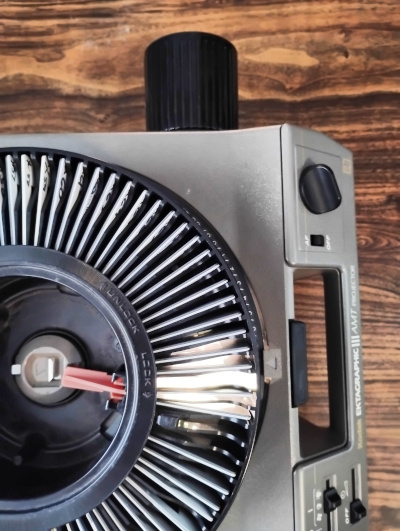
From the top, the small cavity can be seen where the slides drop down into the projector. When the next image is needed, the slide moves back in the tray, the tray creeps forward one slide, then the next slide is moved into the projector.
Were these the good old days of technology? Absolutely not! Making slides was difficult, slow, and expensive. Film developing was part of the process. Slides could be backwards or upside down, which might make a presenter look poorly prepared. The projectors were heavy and noisy. It's hard to think of any positives. Perhaps slide projectors were more resistant to technology failures than computers.
My doctoral dissertation in 1995 was the first and last slide-based presentation that I did. After that, it seemed nearly miraculous when computers were able to print directly to slides, which was soon followed by projectors that didn't need any slides at all. Slideless projectors seemed so easy, so effortless compared to the older technology.
The old hardware is gone now, but the slide projector terminology lives on. Since PowerPoint slides don't slide or move we should really have a term that's more contemporary and accurate. On second thought, I need to keep using the term slides so the book title won't need to be changed.